
What Is Indirect Ownership and How to Trace It?
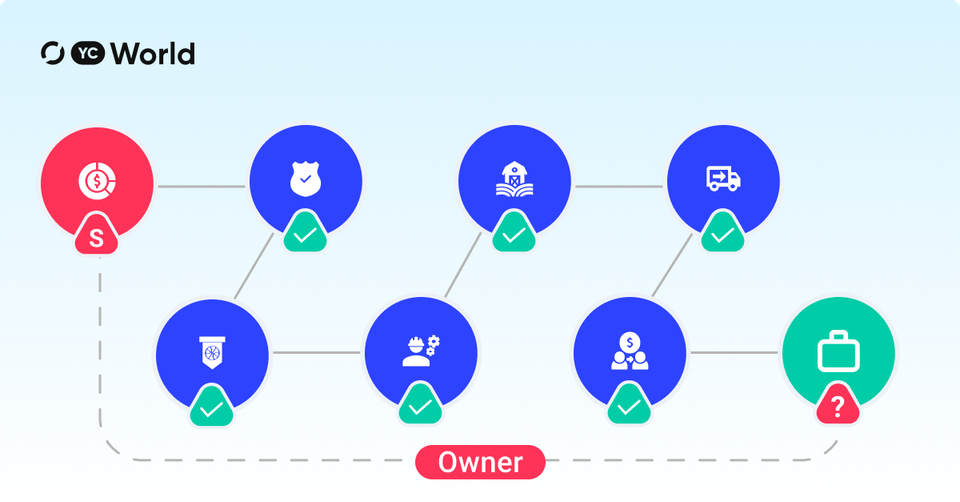
While direct ownership is straightforward, corporate structures often utilise indirect ownership to hold assets through intermediaries like holding companies, shells, and trusts.
Failing to identify the ultimate controllers can lead to severe compliance violations, massive regulatory fines, and catastrophic reputational damage.
Research by the World Bank spanning three decades reveals that nearly 70% of over 200 major corruption cases utilized anonymous corporate structures, such as trusts and shell companies, to hide the identities of the true owners.
In this article, we will break down the mechanics of indirect ownership, explore how beneficial ownership of a trust works, examine the regulatory hurdles posed by corporate opacity, and provide a step-by-step guide to tracing the real individuals pulling the strings in a minute.
What Is Indirect Ownership?
To understand how risk hides in corporate structures, we must differentiate between direct and indirect ownership:
✔️ Direct Ownership. An individual or entity owns shares in a company directly under their own name.
✔️ Indirect Ownership. An individual owns or controls a company through one or more intermediate layers, such as other corporations, legal arrangements, or beneficial shareholders acting on their behalf.
Unlike corporations, trusts are fiduciary contracts rather than separate legal entities. Because they split legal title from economic benefit, trusts are frequently utilised to obscure ultimate beneficiaries, making them a primary focus for compliance officers worldwide.
Beneficial Ownership in Trusts: Who Is the Real Owner?
Determining who is the beneficial owner of a trust requires looking past the legal title. A beneficial owner of a trust (or UBO) is any natural person who ultimately exercises control over the trust or benefits from its assets.
To pinpoint the trust beneficial owner, you must analyse the 5 core roles defined in a beneficial trust agreement:
- The Settlor (the individual who creates the trust and transfers their assets into it).
- The Trustee (the person or professional entity holding legal title to the assets and managing them).
- The Beneficiaries (the individuals who hold a beneficial interest in a trust, meaning they have the legal right to enjoy the income or assets).
- The Protector (an optional third party appointed to oversee the trustee and protect the settlor’s original intent).
- Any other natural person (exercising ultimate effective control over the trust).
Ultimately, the core definition of a beneficial owner comes down to real-world benefit and control. Yet, navigating the private nature of these legal arrangements and the distinct roles of the parties involved means that determining who is actually pulling the strings is an intricate puzzle that requires specialized expertise to solve.
Why Trusts Make Beneficial Ownership Harder to Trace
Trust structures can make beneficial ownership more difficult to identify, particularly when ownership spans multiple jurisdictions. Unlike corporations, trusts are often subject to different disclosure requirements, which can limit public visibility into their structure and beneficiaries.
However, regulators worldwide are increasing transparency requirements. Frameworks such as FATF Recommendations, EU Anti-Money Laundering Directives, the US Corporate Transparency Act, and the UK PSC regime aim to improve access to beneficial ownership information and reduce the misuse of complex ownership structures.
For businesses, understanding indirect ownership is no longer optional. Inadequate visibility into ownership chains can increase compliance risks, delay onboarding processes, expose organisations to regulatory scrutiny, and create significant reputational challenges.
How to Identify Beneficial Owners of a Trust
Identifying the beneficial owner of a trust requires looking beyond the legal structure and tracing the individuals who ultimately control or benefit from the assets. In most jurisdictions, organisations must disclose any individual or legal entity that directly or indirectly owns or controls 25% or more of an entity. This includes ownership held through trusts, partnerships, holding companies, and other intermediary structures.
To determine beneficial ownership, compliance teams typically use the following methods:
Multiplication Test
Calculate the indirect ownership percentage by multiplying ownership stakes at each level of the ownership chain. If the resulting share exceeds 25%, the individual may qualify as a beneficial owner.
e.g.
Person A owns 60% of Company B, which owns 50% of Company C. Person A's indirect ownership in Company C is 30% (60% × 50%), exceeding the 25% threshold.
Rolling Test
Review each link in the ownership chain and follow any entity that holds more than 25% of shares or voting rights. Continue tracing ownership until a natural person with ultimate control or significant influence is identified.
Dominancy Test
Assess whether an individual or entity exercises control over a company that owns more than 25% of the target entity. In practice, control is often established through ownership of more than 50% of shares or voting rights, even when indirect ownership percentages are lower.
Trust-Specific Considerations
When analysing a trust, it is important to examine all parties involved, including the settlor, trustee, beneficiaries, protector, and any other person exercising effective control. The beneficial owner may be one individual or several individuals, depending on how the trust is structured and managed.
YC.World for Identifying Ownership
Accurate indirect ownership analysis starts with a clear understanding of direct ownership relationships.
YC.World automates the mapping of corporate connections across multiple jurisdictions, helping users quickly identify ownership chains and control relationships.
How YC.World Maps Beneficial Ownership Across Jurisdictions in Seconds
By visualising how companies, individuals, and organisations are connected, YC World makes it easier to trace potential UBOs and investigate complex ownership structures that may involve trusts, holding companies, or other intermediaries.
Contact YC.World to schedule a demo and automate your due diligence.
FAQ
What is a beneficial owner of a trust?
A beneficial owner of a trust is a natural person who ultimately benefits from the trust's assets or exercises control over the trust and its activities.
Who is the beneficial owner of a trust?
The beneficial owner of a trust may be the settlor, beneficiary, protector, or another individual who ultimately controls the trust or receives economic benefits from it.
Why is understanding indirect ownership important for compliance?
Understanding indirect ownership helps organisations identify UBOs, assess compliance risks, meet AML requirements, and detect hidden ownership structures that could expose them to regulatory or reputational risks.