
What Is Sanctions Screening? Process, Tools and Compliance
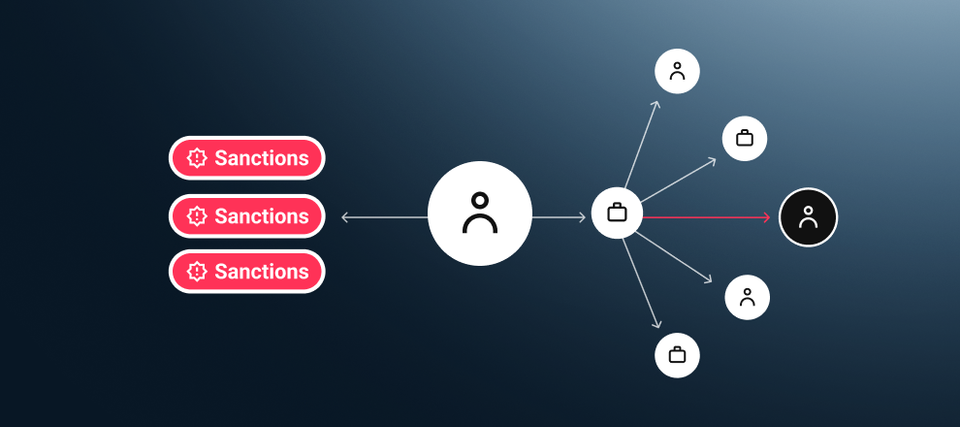
Sanctions screening is the process of checking customers, counterparties, beneficial owners and relevant assets against sanctions lists to identify restricted relationships and potential compliance risks.
For financial institutions, FinTech companies and other organisations operating across borders, basic name matching is no longer enough. Similar names, aliases, different scripts, complex ownership structures and constantly changing sanctions data can create both false positives and overlooked risks.
Sanctions screening therefore goes beyond a one-time check, combining broad sanctions coverage, PEP data and ongoing monitoring throughout the business relationship. When a direct match does not provide enough context, deeper ownership, control and network analysis can help assess potential indirect exposure and better understand the relationship between entities.
Want to strengthen your sanctions screening process?
What does sanctions screening mean?
Sanctions screening means checking an individual, legal entity or relevant asset against sanctions lists issued by governments and international organisations.
Its purpose is to identify whether a customer, counterparty, beneficial owner or related party is subject to restrictions that may affect a business relationship or transaction.
An important distinction is the difference between a one-time check and continuous compliance verification.
A one-time check validates a counterparty at a specific point in time, typically during onboarding. However, sanctions status, ownership structures and related risk factors can change after that initial review.
Screening for AML and screening for sanctions may be performed within the same compliance workflow, but they address different risk areas. AML procedures are designed to identify and manage broader financial crime risks, while sanctions screening focuses on restrictions imposed under applicable sanctions regimes.
The same applies to PEP and sanctions screening. A Politically Exposed Person is not automatically sanctioned, and PEP status itself does not imply prohibited activity. However, both checks are commonly included in risk-based customer due diligence because they provide different types of information about a customer or counterparty.
Sanctions Screening Lists and Global Coverage
The effectiveness of a screening programme depends heavily on the quality, coverage and freshness of the underlying data.
Sanctions screening lists are published by governments and international organisations to implement measures such as asset freezes, trade restrictions and restrictions on certain transactions or relationships.
A global sanctions list screening programme may include major sources such as:
- the United Nations Security Council Consolidated List;
- European Union sanctions lists;
- the US Office of Foreign Assets Control Specially Designated Nationals and Sanctions List Search;
- other relevant international and national sanctions sources depending on the organisation's operations and exposure.
Coverage alone, however, is not enough.
Sanctions data changes over time. Individuals and companies can be added to or removed from lists, identifying information may be updated, and new ownership or control relationships may become relevant.
For this reason, an effective sanction list screening process should consider not only the number of lists available but also:
- how frequently the underlying data is updated;
- whether aliases and alternative spellings are captured;
- whether additional identifiers are available to verify a match;
- whether sanctions information can be traced back to the original source;
- whether related companies, beneficial owners or assets can be investigated.
Where can direct sanctions screening leave gaps?
Traditional screening often focuses on a single question: Does this name appear on a sanctions list?
That approach can create two major problems.
- The first is excessive false positives. Common names, spelling variations and transliteration differences can generate numerous alerts that analysts must review manually. To distinguish a true match from a false positive, analysts typically compare additional identifiers such as date of birth, nationality, jurisdiction, position, associated organisations or other available biographical details. If these attributes do not align with the screened person, analysts can usually dismiss the alert; where the data is incomplete or ambiguous, further verification may be required.
- The second is missing context. An entity may have no direct sanctions match, even if its beneficial owner, parent company, related entity, or connected asset is subject to restrictions. Consider a corporate counterparty with a clean direct screening result. A deeper ownership review may reveal that the company is connected to a sanctioned individual or entity at several levels.
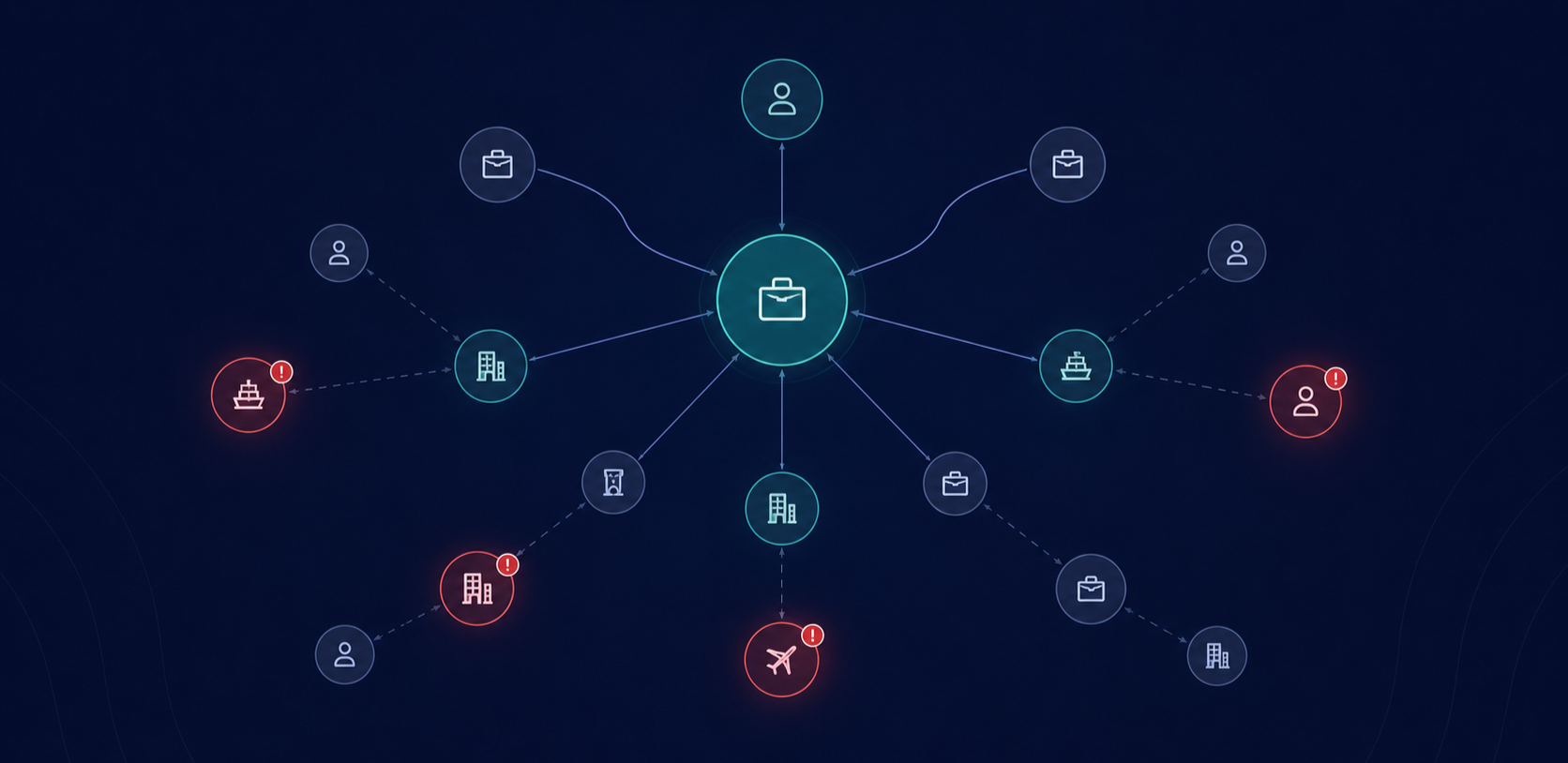
The same principle can apply to assets. Depending on the nature of the business, vessels, aircraft or other identifiable assets may also be relevant to sanctions due diligence.
Instead of asking only whether a company appears on a sanctions list, compliance teams should also ask:
“Who owns or controls this company, what other entities and assets are connected to it, and are any of those relationships relevant to sanctions risk?” ← this broader approach can improve both the quality of screening and the efficiency of subsequent due diligence.
Sanctions Screening and Network Analysis with YC World
When a screening result requires deeper review, YC.World helps investigate ownership, control and related parties around the counterparty.
The platform consolidates data from 80+ countries and 350 public sources and visualises relationships between companies and individuals across jurisdictions.
In YC World, analysts can investigate whether a counterparty has a sanctions indicator and then explore related information, including:
- beneficial owners and corporate ownership links;
- connected legal entities and individuals;
- sanctions associated with related parties;
- relevant vessels and aircraft;
- historical changes available in source data;
- common identifiers that can help reveal connections;
- direct references to available sanctions source documents.
This is especially useful when an organisation already performs bulk screening through an internal system but needs deeper investigation of selected counterparties.
Effective sanctions screening is an ongoing compliance process, not a one-time search. Screening identifies potential matches, while ownership, control and network analysis helps determine what those matches or connections mean in practice.
Improve your sanctions screening today.
Request a free YC World demo
What is sanctions screening?
Sanctions screening is the process of checking individuals, companies, beneficial owners and relevant assets against sanctions lists to identify relationships or transactions that may be subject to restrictions.
What are sanctions screening lists?
Sanctions screening lists are datasets published by governments and international organisations containing individuals, entities and, in some cases, other designated subjects of sanctions measures. Organisations use these sources as part of their compliance and risk-management processes.
What is the difference between sanctions screening and PEP screening?
Sanctions screening identifies whether a person or entity is subject to sanctions-related restrictions. PEP screening identifies individuals who hold or have held prominent public functions and may therefore require enhanced risk assessment. PEP status does not mean that a person is sanctioned.
How does sanctions screening work with AML processes?
Sanctions screening is often integrated into AML and KYC workflows during onboarding, periodic reviews and ongoing monitoring. It provides sanctions-specific risk information alongside other due diligence checks.